
In Honduras, gastric cancer is often caught late. Without widespread screening, patients frequently don’t seek care until symptoms are advanced. By the time they reach the operating room, the surgical challenge is no longer simple – it requires removing not just the tumor, but the metastatic lymph nodes around the stomach that, left behind, can cause the cancer to return.
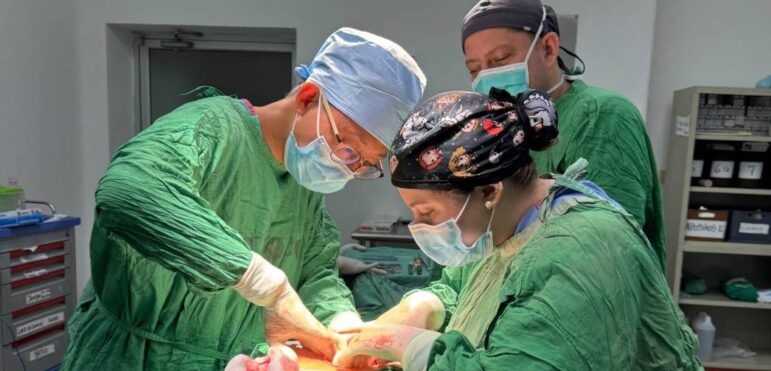
Dr. Kenta Matsushita, an HVO volunteer and surgical oncologist from Japan, spent a week training residents at San Felipe Hospital in Honduras on vascular anatomy, lymph node dissection techniques, and the proper use of surgical staplers. He found the residents talented and eager to learn, quickly absorbing new material and photographing the intraoperative vascular anatomy for further study. They had previously focused only on removing tumors, but, after learning from Dr. Matsushita, they now understand they must go further, to ensure no small metastatic lesions are left behind. “This knowledge will save lives,” Dr. Matsushita said.
Another life-changing skill was familiarity with surgical staplers. In Honduras, patients must supply their own staplers for procedures, so residents rarely get hands-on training with them. “When I showed them how to use the staplers, they were so excited to learn,” Dr. Matsushita said. “If a patient requires a total gastrectomy and we don’t have a circular stapler, the tumor resection may be inadequate or postoperative complications could increase, making the rest of their life so much more difficult.”
Dr. Matsushita believes deeply in HVO’s model of education. “If I come just to perform surgeries, once I leave, they have nothing left. But if I educate them, the knowledge and techniques are left behind and are passed on to new residents – and it continues.” He acknowledges that one week wasn’t enough to teach the residents everything, and hopes to return someday.
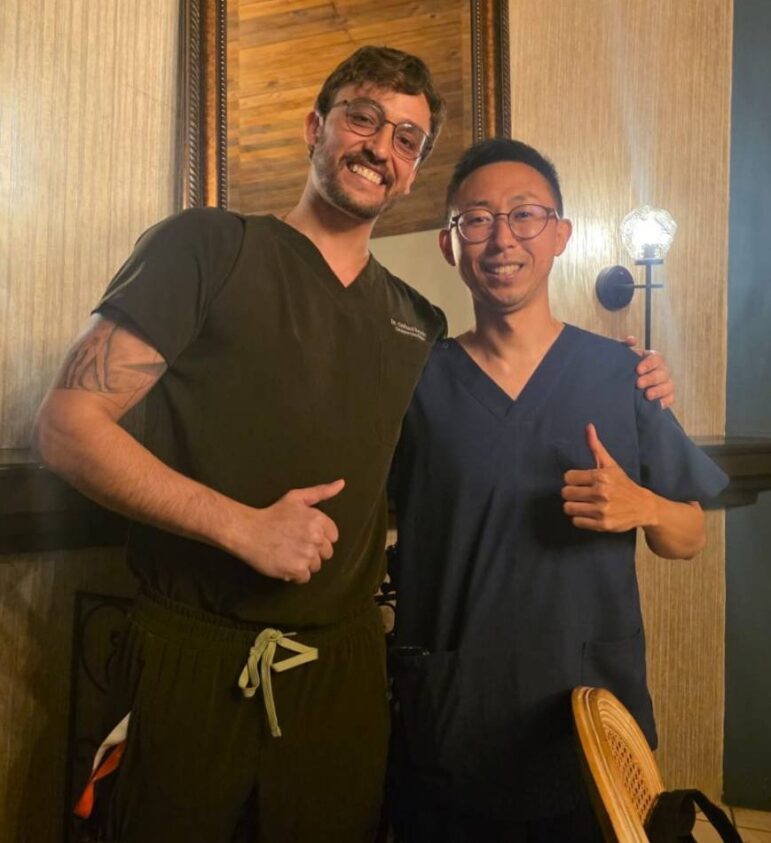
“I recommend volunteering to everyone who can,” he said. “I felt empowered by the enthusiasm of the residents. My imagination expanded after this experience. Now, at home, I try to think, ‘Is there another way to perform this technique with just basic or more convenient material?’ But the most exciting thing for me was how kind and eager to learn everyone was.”