Dr. Neil Kay has been volunteering with HVO’s oral health project in Vietnam for thirty years and in that time has completed over forty assignments. Dr. Kay first visited Vietnam with his wife, a physical therapist volunteering with HVO’s rehabilitation project at the University of Medicine and Pharmacy in Ho Chi Minh City. When word got around that a volunteer’s husband was an orthodontist, the oral health department, which at the time consisted of general dentists, requested their own project to bring in specialized training. Dr. Kay proposed the project to HVO, and it was launched in 1994.
“The HVO program is the only one I know of that has a long-term commitment to teaching,” said Dr. Kay about why he became part of HVO. “Orthodontics is a long-term commitment. We can’t go in and put patients on a braces and say good-bye. They’ll need treatment and guidance for the next two years. So, for me, finding a program that we could continue with myself and other volunteers, a structured program over time, that was essential. HVO provides a stable and standardized program, helping volunteers link together in a big picture. You’ve got a project director to work with and tell you how things are rather than going in blind.”
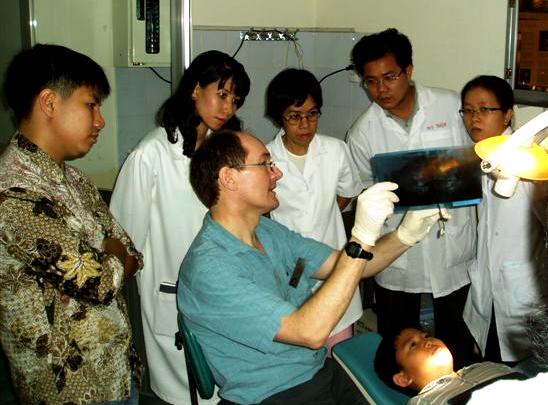
Dr. Kay began visiting three times a year for two weeks at a time, training faculty members at the university. Soon, the head of the orthodontics department in Hanoi, along with her vice chair, began to fly to down to join the trainings. “I’m not a professor,” Dr. Kay said. “So I just ran through what I do in my office, showed them how I make diagnoses, what I do for treatment, the materials I use. I was fortunate that orthodontics supply company I worked with generously donated a tremendous amount of materials I was able to pass on to my students to use for practice and for patients.” HVO soon connected Dr. Kay with a volunteer who was a professor – Dr. Jean-Marc Retrouvey of McGill University in Canada. “Jean-Marc has incredible, encyclopedic knowledge,” said Dr. Kay. “The two of us made a great team. He led the didactic side of things, and I would stop him and say, ‘Well that’s the theory, but here’s what it means in practice to a clinician.’ Students would look to us for different things.” Dr. Retrouvey had all kinds of teaching materials already prepared, including lectures and photographs. Together, they developed a six-part program titled “Diagnosis and Treatment of Mild to Moderate Malocclusions” that included webinars, quizzes, and practical work with patients. The number of students grew.
Each program took two years to complete, and they ran four programs of approximately twenty students each. The programs were hybrid virtual and in-person. Dr. Kay and Dr. Retrouvey found that their students truly learned the material and were able to then help others who had not gone through the program understand complex concepts. “Our students were able to explain things to everyone else because we had a full program, not just one lecture,” explained Dr. Kay. “We noticed people who had worked with us were being looked to for a data source. We had taught them well enough that they had both a good theoretical and clinical basis to work from and were able to teach others.”
Aside from the specific topics taught in the program, Dr. Kay says that one of the biggest impacts he made was by training students to look at their notes on each patient before doing anything. “You don’t look in the patient’s mouth first,” he said. “You look at your notes. It makes a big difference, emphasizing the importance of keeping notes, and I had them use the same format as the ones I use in my own office. It’s a standardized way of looking at things, gives you the dates of what you did and what you expect to do next time. In the first five years, that was the biggest thing that occurred.”
Many of Dr. Kay’s and Dr. Retrouvey’s former students are now in leadership positions, including the heads of departments at multiple universities and hospitals, and the son of one of their first students is now the leading Invisalign expert in Southeast Asia. Their former students are invited as speakers at international conferences and teach their own courses. Dr. Kay and Dr. Retrouvey also helped found two orthodontic associations in Vietnam.
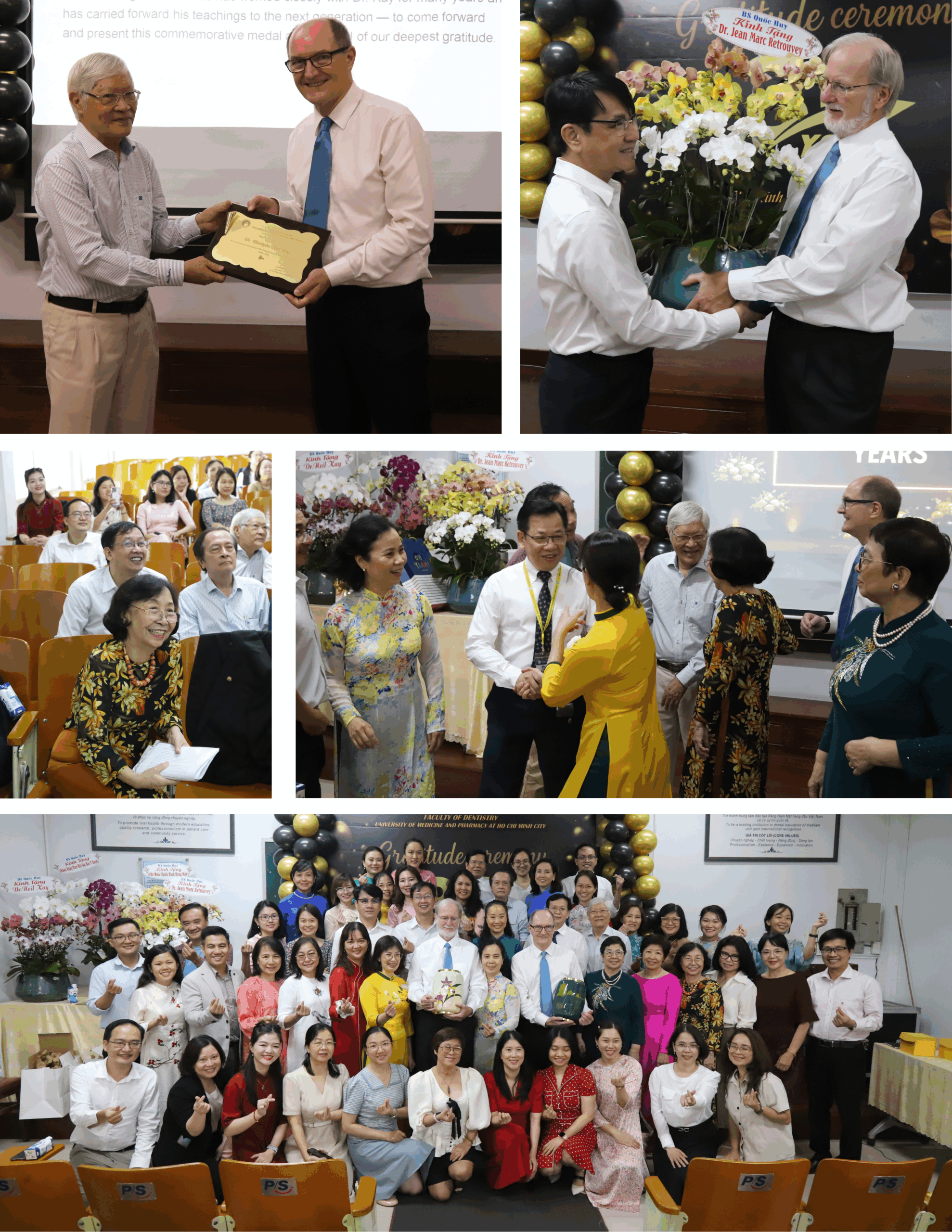
The University of Medicine and Pharmacy held a gathering in early 2025 to honor Dr. Kay and Dr. Retrouvey. “At the meeting, they told us that without our teaching they would not be where they are now,” said Dr. Kay. “It took me by surprise. They did this as a thank you to us.” Over one hundred former students and faculty came from all over to see Dr. Kay and Dr. Retrouvey and thank them in person.
While HVO’s official project is winding down, Dr. Kay still plans to assist with the development of 3D printer use. 3D printing will allow cheaper, faster production of essential orthodontic materials and will help bring critical resources to patients who otherwise would not have access. This technology is being used and taught at HVO’s project site in Nepal, and the volunteers responsible for the training will be swapping notes with Dr. Kay and Dr. Retrouvey. In Nepal, volunteers have been focused on printing dentures. In Vietnam, they will focus on aligners.
If you are interested in learning about current opportunities with the oral health program, contact Program Manager Lauren Franklin at l.franklin@hvousa.org.
Some kind words from just a few of Dr. Kay’s former students:
“I remember this time back in 1994, when I, a resident from Hanoi Medical University, had the opportunity to attend the very first course on fixed orthodontic appliances at the Faculty of Odonto-Stomatology, UMP. This was made possible through the support of HVO and taught directly by Dr. Neil Kay.
Before 1994, we treated patients solely with removable appliances, which had many limitations and left many cases untreatable. From that first course, we gained knowledge that enabled us to start using fixed appliances for treatment and to spread that knowledge to other doctors who pursued orthodontics later on.
Everything I have today in life and in my career, I owe to the teachers who have passed on their skills and passion to us. They ignited our enthusiasm so we can continue to guide the next generation, helping Vietnamese orthodontics grow stronger, gain recognition internationally, and contribute to a better healthcare system for our people.”
– Dr. Nguyen Thi Thu Phuong
“In the early difficult years, Dr. Neil Kay and other HVO doctors not only enthusiastically shared their knowledge and experience but also provided essential materials and tools for orthodontics. During the first five years, HVO doctors actively imparted foundational orthodontic knowledge using straight-wire techniques and pre-adjusted brackets, which were among the most modern techniques at that time.
Dr. Neil Kay and the volunteer orthodontists of HVO laid a solid foundation for the practice of orthodontics from its early days, allowing the specialty to grow and thrive as it does today.
Since 1994, Dr. Kay has generously devoted his time, effort, and heart to supporting our field. He has shared his knowledge, introduced new techniques, and played a vital role in building the strong foundation we stand on today.”
– Dr. Dinh Vinh Ninh
“To us, our teachers were not just lecturers. They were true mentors – those who inspired us, guided our thinking, and instilled a professional philosophy in our work.
There is a saying in Vietnam: “He who teaches you even one letter is your teacher.” We are truly grateful to have learned the proper and scientific orthodontics from such esteemed teachers.
A student from Course K3 has become the first Vietnamese doctor invited to join the Global Advisory Board of one of the world’s leading aligner companies. Among the 12 members on that board, this Vietnamese student met another member – from Canada – who also happened to be your student.
Two out of twelve global board members being your former students speaks volumes about the far-reaching impact and success of your teaching careers.
We know there is no material gift that can truly express our gratitude. Our real gift is this: the effort to practice every day with care, integrity, and dedication – to be worthy of saying we were students of Dr. Retrouvey, Dr. Kay, and Ms. Suzanne.”
– Dr. Nguyen Ho Quynh Anh
“A long-term cooperation program in training and education requires indeed a strong commitment from both sides. The motivation for a non-profit cooperation program like this can only come from individuals who possess a desire to share knowledge, exchange experiences, and foster friendships I believe that any cooperation program must adapt over time and according to the actual circumstances.”
– Dr. Huỳnh Anh Lan