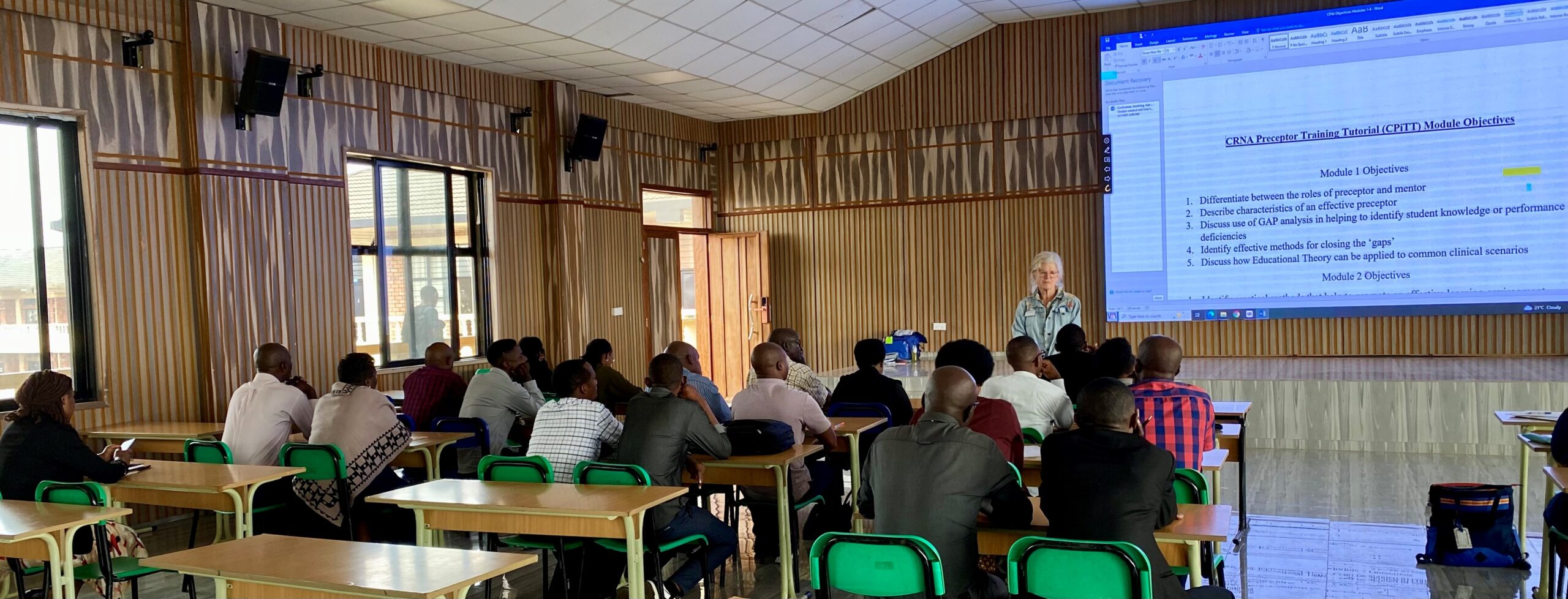
Janet Dewan, PhD, CRNA has been volunteering in Rwanda since 2010 and with HVO’s anesthesia project with the University of Rwanda since 2023. Her decades working in low-resource areas have convinced her of the critical importance of education. “Right away, the mantra of ‘train the trainer’ appealed to me as sustainable,” Dr. Dewan remarked, recognizing how many HVO trained professionals go on to train others as professors, lecturers, and mentors. After COVID shutdowns began to lift, she traveled to the University of Rwanda as an HVO representative to determine whether the project could reopen. Thanks to her assessment, the project resumed in 2023.
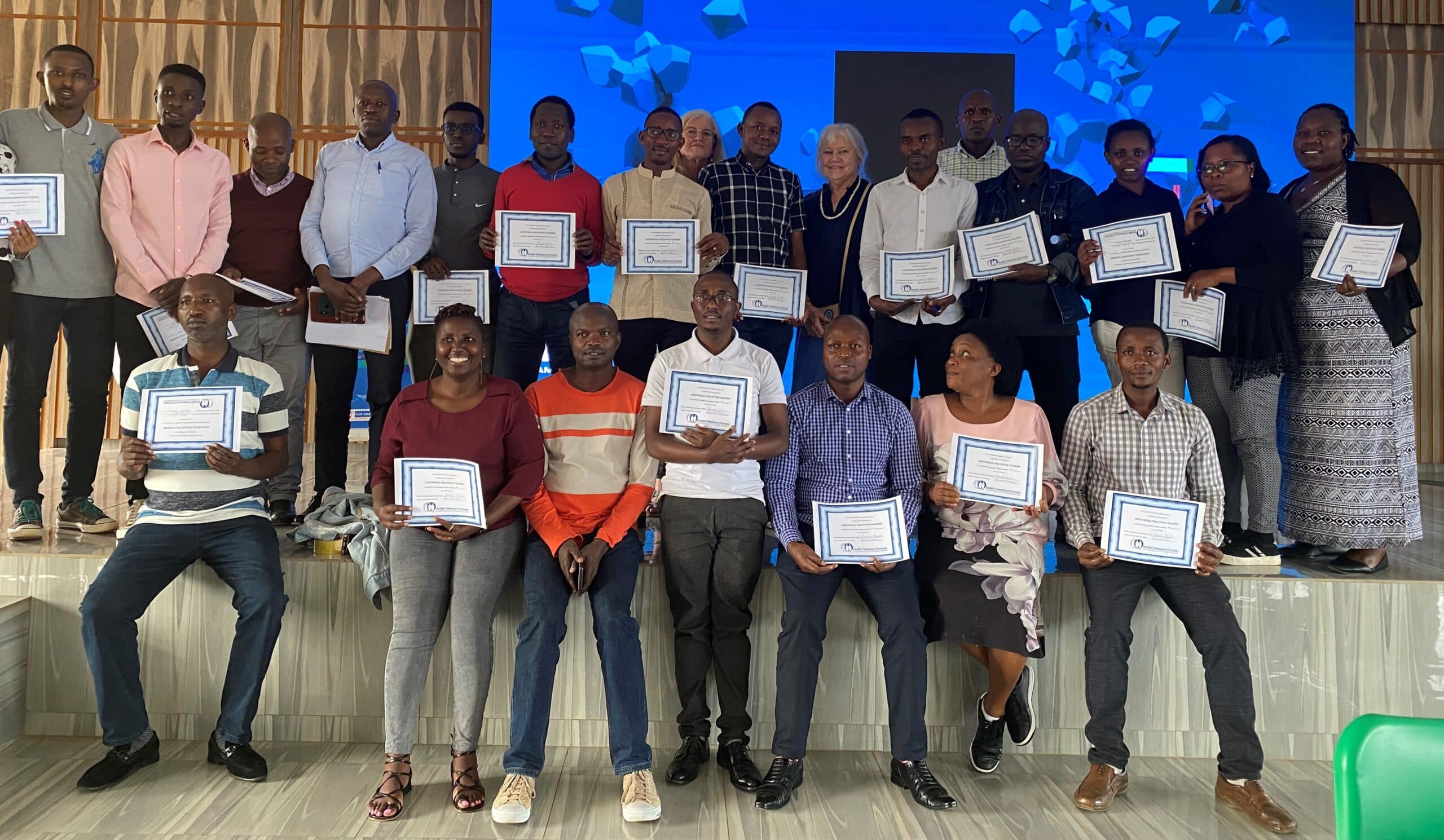
One of the big changes she has seen since then has been the launch of a bachelor’s degree program at the University of Rwanda, which provides anesthetists with clinical training and an academic credential, opening a path to career advancement. After identifying the need, the university signed an MOU with HVO to enlist volunteer CRNA and MD anesthesiologists to help with lectures and support curriculum development. “HVO was very involved in establishing faculty support for the entry and post BS University of Rwanda degree programs,” she said. “HVO did a lot of training, and not just of the basic undergrads, but also of the practicing anesthetists who returned to earn their post certificate bachelor’s degrees. Volunteers taught resuscitation, trauma, ultrasound blocks, and more advanced topics to already practicing anesthetists earning the degree. Since I started visiting Rwanda, the number of nurse anesthetists has more than tripled. In 2010, the director told me that since the 90s he had graduated 196 students. Now, there are over 600 practicing nurse anesthetists. Though the need is there for more, the increase in number of trained anesthetists greatly expands access to safe anesthesia.” Dr. Dewan herself taught several nurse anesthetists who are now instructors.
Following the success and expansion of the bachelor’s degree program, university leadership shifted their focus to establishing a nurse anesthesia master’s degree program. Twenty-five students are currently enrolled in the three-year Master of Nurse Anesthesia and Critical Care degree program. Half of them received their bachelor’s degree through the HVO-supported university program. HVO Project Director Robin Naden-Semba, MS, MSN, CRNA and Dr. Dewan have worked with the university and the Ministry of Education to develop the graduate degree program over years as consultants and educators. Dr. Dewan has been impressed with the level of education students are being provided. “The University of Rwanda has high education standards comparable to what I see here in the US,” she said.
Dr. Dewan shared the story of one student she has gotten to know:
“There was one nurse anesthetist I came to know very well. When I met him, he was a diploma-credentialed anesthetist. I knew he was talented. He went back to school to get his bachelor’s degree in the degree completion program supported by HVO. During his post certificate BS training, he met another HVO volunteer, Dr. David Rudnick. Dr. Rudnick taught him, along with several other graduates, skills that were not being taught in the basic program, particularly in the use of ultrasound, and established a long-term relationship. Dr Ruddick made sure this nurse anesthetist became comfortable with ultrasound skills, and I’m sure he will now go on to teach others. Because he got his bachelor’s degree, he was able to get a better job and is now in charge of safety education in his department. I always see him when I travel to Rwanda. He was accepted to the first class of MS students and is now developing leadership specialty skills in the graduate program.”
Dr. Dewan also shared the story of a moment her teaching made an immediate, life-saving impact:
“For a case I was observing, I asked the nurse anesthetist in the room if they had a video laryngoscope because the patient looked like he might have a difficult airway. The anesthetist told me they had one, but she didn’t know how to use it. She brought one out, and, in less than ten minutes, I had provided basic instruction, and she used it to skillfully secure the airway. The equipment was available but practicing anesthetists had not been taught how to use it. These are devices that can save a life. Now she can use it and train her colleagues.”
To meet the global shortage of skilled health care workers, Dr. Dewan believes part of the solution starts with training local colleagues so expertise can grow from within. She points to a striking example of what that education can lead to: “I know two nurses who were inspired to study nurse anesthesia because lifesaving, skilled, compassionate treatment they experienced from nurse anesthetists when they contracted the Marburg virus in 2024. That treatment, which inspired others, was thanks to higher-level education, and HVO contributes to that.”
This year, Dr. Dewan was awarded the 2026 Agatha Hodgins Award for Outstanding Accomplishment by the American Association of Nurse Anesthesiology (AANA). The award recognizes individuals whose dedication to excellence has furthered the art and science of nurse anesthesiology. Dr. Dewan is being honored for her decades of leadership in nurse anesthesia education and clinical practice, as well as her extensive work advancing anesthesia education and supporting providers, students, and faculty in Africa. AANA will present the award during its 2026 Annual Congress, August 21–25, in Boston. HVO will have staff present at booth #1246 to share information about HVO programs. Stop by to say hello!