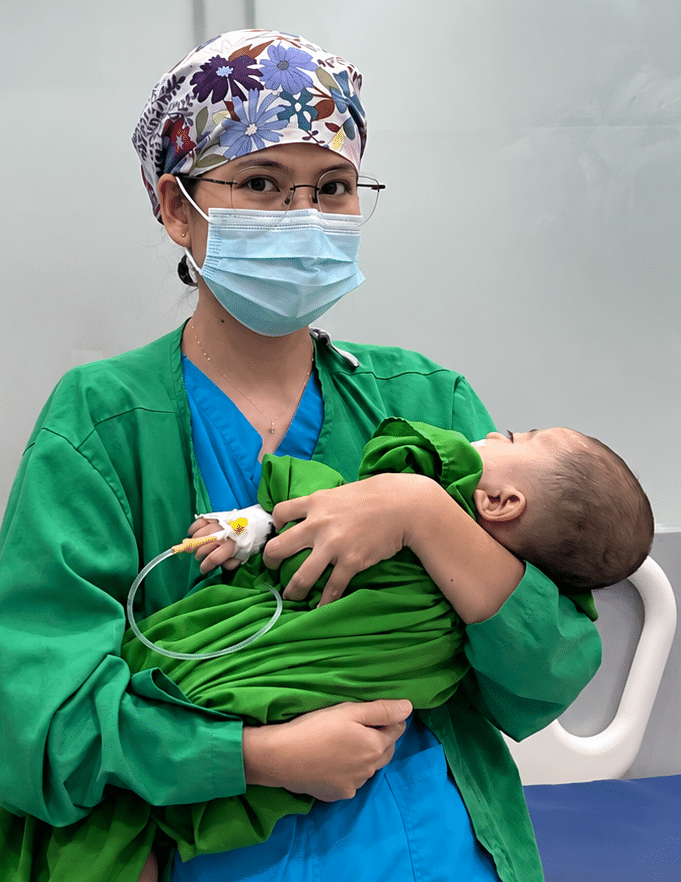
Malin Try is a nurse anesthetist at Angkor Hospital for Children (AHC). In 2026, she received a Wyss Scholarship to attend the American Association of Nurse Anesthesiology (AANA) conference in Boston and spend time at the University of Pittsburgh with HVO Project Directors Sara Schmack and Derek Schmack and HVO volunteers Richard Henker, Michelle Smith, and Kitra Henker. The trip followed training from HVO volunteers at AHC.
Her journey reflects the lasting impact of training provided by HVO volunteers at AHC. Before training with HVO volunteers, Ms. Try lacked confidence in her clinical decision-making. She tried to deepen her understanding of anesthesia by watching educational videos on YouTube, searching Google, and reading anesthesia textbooks. “It wasn’t enough. We had to learn how to deal with problems as they came up,” she said. “By teaching us, HVO volunteers helped us learn to prevent problems from happening in the first place. We are now better able to recognize issues quickly and avoid complications.”
Despite limited local resources, HVO volunteers provided training in anatomy, physiology, pharmacology, and simulation. They also shared their clinical experiences and practical approaches to patient care. This helped Ms. Try become more confident in assessing young patients, making clinical decisions, and developing appropriate management plans. She believes these skills have improved patient safety and outcomes. “We frequently used ketamine maximum at maximum dose for burn patients, and some patients woke up experiencing delirium, agitation, and pain,” she explained. “HVO volunteers introduced us to multimodal pain management techniques.”
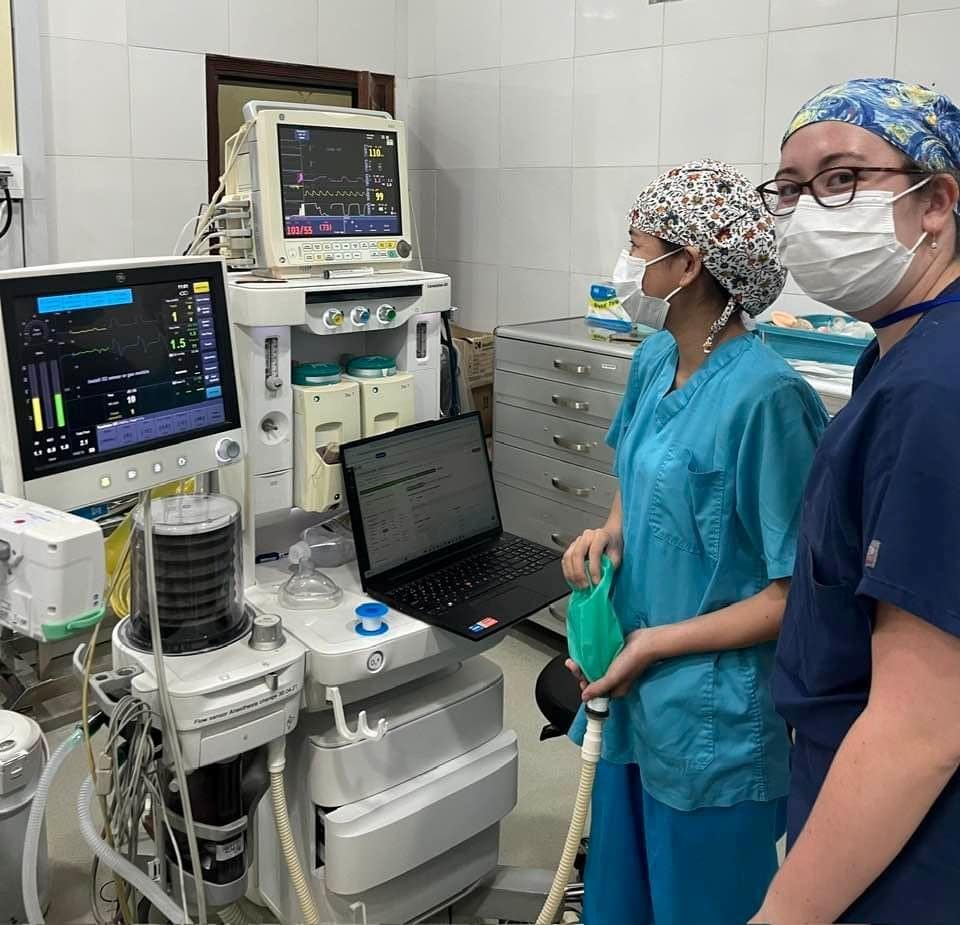
Dr. Henker also introduced the team to dexmedetomidine, a medication that provides sedation and some analgesia with relatively little respiratory depression when appropriately administered. Ms. Try learned how it could be incorporated into an anesthetic plan to reduce ketamine requirements and help patients recover more smoothly, with less agitation. “This has been especially helpful for burn patients who need to return to the operating room repeatedly for wound dressing changes,” she said. “Dr. Henker also taught me about fluid management for burn patients. He helped me feel more comfortable and confident when administering medications and managing these patients. It is already frightening for children to experience burns and undergo surgery. The medications and techniques I learned from HVO volunteers have helped us provide better care and improve patient recovery.”
Another lesson from HVO volunteers that Ms. Try found especially important was on new techniques and approaches regarding regional anesthesia, which can improve pain control while reducing the need for opioids.
Ms. Try remembered one patient with compartment syndrome. “Previously, we had never tried regional anesthesia for these patients because we were concerned about being able to assess the affected limb and ensure the patient could still move after surgery.” Dr. Justin Johal introduced the team to research and clinical approaches showing how a carefully selected regional nerve block using a low concentration of local anesthetic could provide effective pain relief while preserving important motor function in appropriate patients. “It worked really well for pain control. The patient could still move his hand and was no longer in pain. I really appreciated what Dr. Justin Johal taught us,” said Ms. Try.
Regional anesthesia can help reduce opioid requirements and, in turn, may decrease opioid-related side effects such as nausea and vomiting. With effective pain control and an appropriate recovery plan, patients may also be able to resume eating and drinking sooner. For Ms. Try, this experience demonstrated how new knowledge can change the way a team approaches pain management, even when working with limited resources. “Dr. Johal also taught us how to do a gastric antrum ultrasound,” she said. “It’s best for us to make sure patients have no gastric contents, especially trauma patients.”
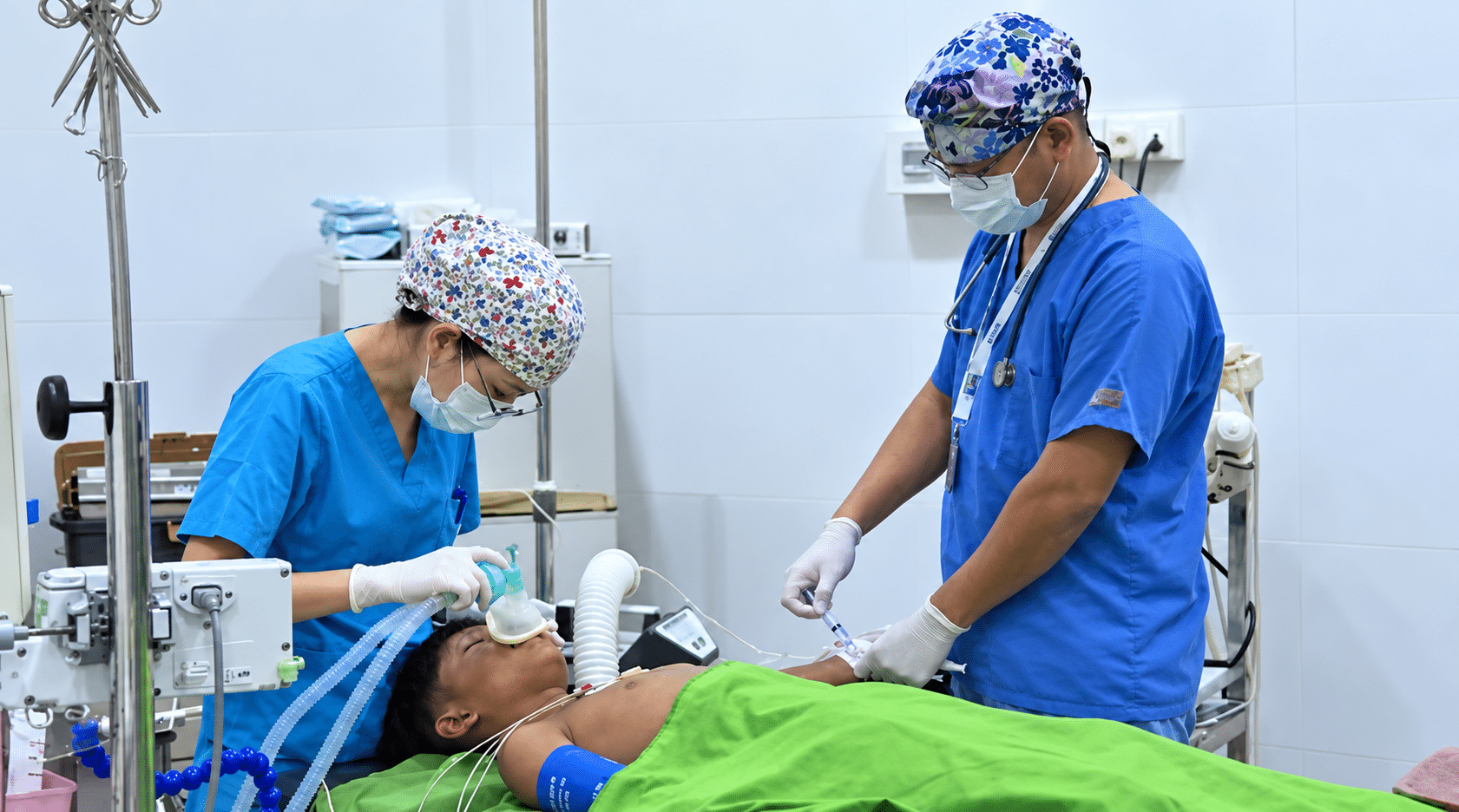
Ms. Try remembered another patient from earlier in her career: “One of the first times I remember HVO training, we had a burn patient come in for surgery. We knew we couldn’t use succinylcholine to intubate a burn patient because of the risk of hyperkalemia, and we had to do a rapid sequence induction. I asked myself, ‘What is the best option for this patient?’ Dr. Henker brought us a new technique: we could intubate with deep inhalational anesthesia, fentanyl, and propofol, without a muscle relaxant. It worked really well.”
More recently, Ms. Try had a patient who could not be intubated because of a high risk of aspiration. She was not sure what she could do for the patient until HVO volunteers taught the team to apply cricoid pressure with gentle ventilation. “When the patient desaturated quickly, we used cricoid pressure and kept the ventilation pressure low, positioning the patient with his head elevated when appropriate. The patient did not aspirate. We still use the same technique today.” Not only did that one patient have a better outcome, now all future patients will receive the same life-saving care. Ms. Try gave another example: “I think the best thing we learned from HVO is how to extubate tonsillectomy patients so that there is no bleeding, and you can give Precedex to relieve pain. No coughing or agitation. And it’s not just one surgery; it works for many surgeries.”
That is the amazing thing about passing on knowledge – the benefits do not end when volunteers leave. Not only is Ms. Try implementing the new techniques she has learned, she is teaching them to others. “I give lectures about medication by Zoom, and now when I’m in the operating room, sometimes doctors come to learn about airway management. I teach them the anatomy, how to position the patient, the technique to open the airway and insert the tube, how to confirm placement by auscultation, how deep the tube should be for each patient, which medications to give before intubation, and how to handle difficult intubation and complications. I have also taught students from the University of Pittsburgh how to provide regional blocks for pediatric patients. I am also teaching my classmates at the university. Because I learned from HVO and have access to educational materials and lectures, I can teach them anesthesia, pharmacology, and physiology. I want to help them build their knowledge and confidence, just as the HVO volunteers helped me build mine.” Teaching has become an important part of Ms. Try’s professional goals. She hopes to become an educator and help strengthen anesthesia education and patient care throughout Cambodia.
Ms. Try appreciates the time and attention volunteers have given her and the department, and the opportunity to travel to Boston to learn and network at the AANA conference: “I appreciate everything the HVO volunteers have done for me: Rick Henker, Derek Schmack, Kit Henker, Michelle Smith, and Justin Johal. They didn’t just teach us to do anesthesia; they taught us how to think about anesthesia. It was never, ‘You should do it this way because that’s how they do it in the United States.’ They listened, they understood our resources, and they shared their clinical experience. They always motivated me to keep learning, to improve education and patient safety. They didn’t only teach. They also helped prepare our hospital’s protocols to improve patient safety, and those are still working well today. Thank you to everyone at HVO for giving me the opportunity to come to the U.S. I attended the AANA conference, spoke with Derek and Michelle about anesthesia in Cambodia, and learned so much. I enjoyed every session. I’m truly grateful.”
This is HVO’s model in practice. Not only does Ms. Try have new knowledge and skills to better care for patients for years to come, now so will all of her students and theirs. Generations of children will receive the benefits of this training. To learn more about volunteer opportunities with the anesthesia program, visit HVO’s anesthesia specialty area page.