
Hospitals are meant to be safe havens. Sonja Kill Memorial Hospital (SKMH) in Kampot, Cambodia is striving to ensure that not only are they offering the highest quality clinical care, but also the highest standard of patient safety. Hospital administrators are working to receive national accreditation, a distinction that will increase their profile and help attract more patients and additional funding. This management project represents a new area of engagement for HVO, which has traditionally focused on strengthening clinical care.
Accreditation is a grueling process meant to ensure high standards are met in a variety of areas. For four years (2021-2024), USAID supported the hospital’s efforts. When that support was suddenly cut off, SKMH reached out to HVO for assistance. Volunteers Dr. Connie Evashwick and Ms. Virpi Teinila put together a team from San Diego State University to work with local hospital administrators on environmental safety and security, an accreditation standard focused on ensuring the hospital building and grounds are free of dangers and prepared for man-made and natural disasters.
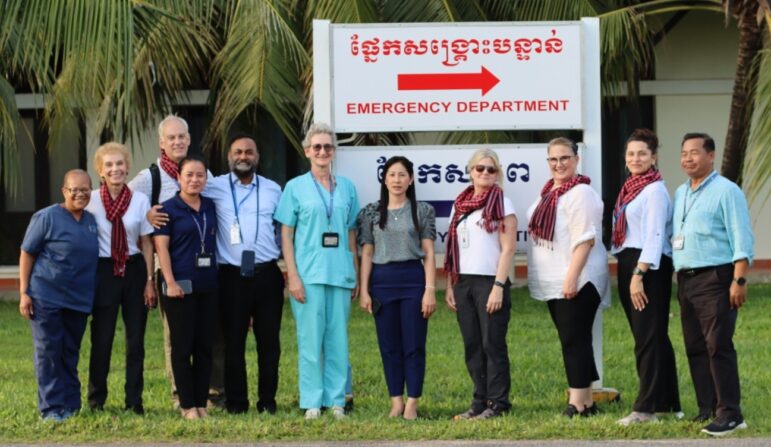
The six-member team included three students in the San Diego State University Doctorate of Public Health (DrPH) Program. Team members were Virpi Teinila, RN, an expert in international disaster management, having worked on 15 response efforts in six countries in Africa, Europe, Asia, and the Caribbean; Connie Evashwick, ScD, FACHE, a professor of health management and policy who has been volunteering with HVO since 2013; Dr. Mahbubur Rahman, a senior administrator in behavioral health provider at Tarzana Treatment Centers in Los Angeles, CA; Ms. Tanya Penn, a seasoned researcher leading a multi-disciplinary center at San Diego State University in San Diego, CA; Ms. Maria Angela Soto, a senior official in the Department of Health, New York City, New York; and Mr. Jordan Penn, a researcher in orthopedic services at Scripps Clinic, San Diego, CA. These mid-career students already have years of experience in health care management but are required to do additional “practical” work for three units of academic credit. Their combined expertise positioned them well to tackle the complex details of accreditation.
The team began working with SKMH senior leaders before they set foot on Cambodian soil. They created an extensive scope of work, detailing the trip’s time frame, necessary documentation, assigned roles, and planned activities. Upon arrival, they set to work engaging hospital staff, from administrators to clinicians to maintenance, to articulate how they manage disasters and ensure patient safety and security.
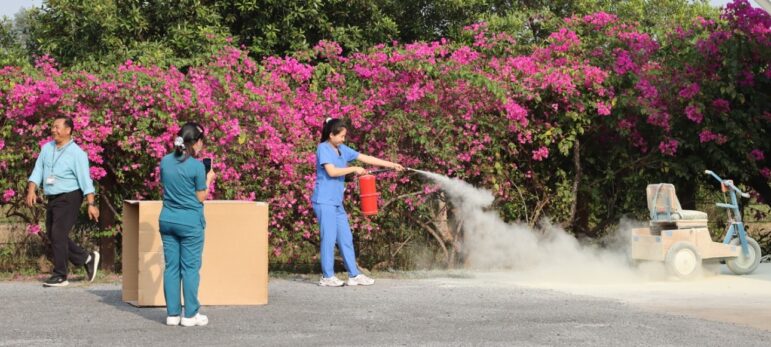
“One of the most notable contributions the team made was to conduct a fire drill,” said Dr. Evashwick. “When we first started talking to them, months before we arrived, they said they didn’t know if they could do it. But the day after we got there, we were told we could go ahead. We took this as a sign of trust, largely based on our affiliation with HVO and the hospital’s long-standing relationship.” They trained over 140 hospital staff on fire safety, evacuating the buildings and engaging all levels of staff members. “We reached more than half of the hospital’s staff in one training session,” said Dr. Evashwick. “And it’s strictly due to HVO. That’s an undeniable accomplishment. It improved staff skills, enhanced patient quality, and saved the hospital several thousand dollars in contracting with an external company to conduct the training.” Ms. Teinila remembers looking over her shoulder to see Dr. Cornelia Haener, the hospital CEO, celebrating with everyone in the hospital courtyard after the successful drill: “I got very emotional when I witnessed this.”
Mr. Sou Kin, Chief Administration Officer at SKMH, shared his perspective: “The HVO team helped strengthen our Disaster Management Plan by reviewing our drafted documents, providing fire safety training, and leading practical exercises such as fire-fighting and patient evacuation drills. Their guidance helped ensure our procedures are clear and effective. Staff are now more confident and better prepared for emergencies. Procedures are clearer, and overall hospital safety has improved.” Together, the HVO team and local staff brainstormed roles individuals can take in each situation and encouraged critical thinking. One priority was discussing actions the hospital can take to make the most impact with the least expense.
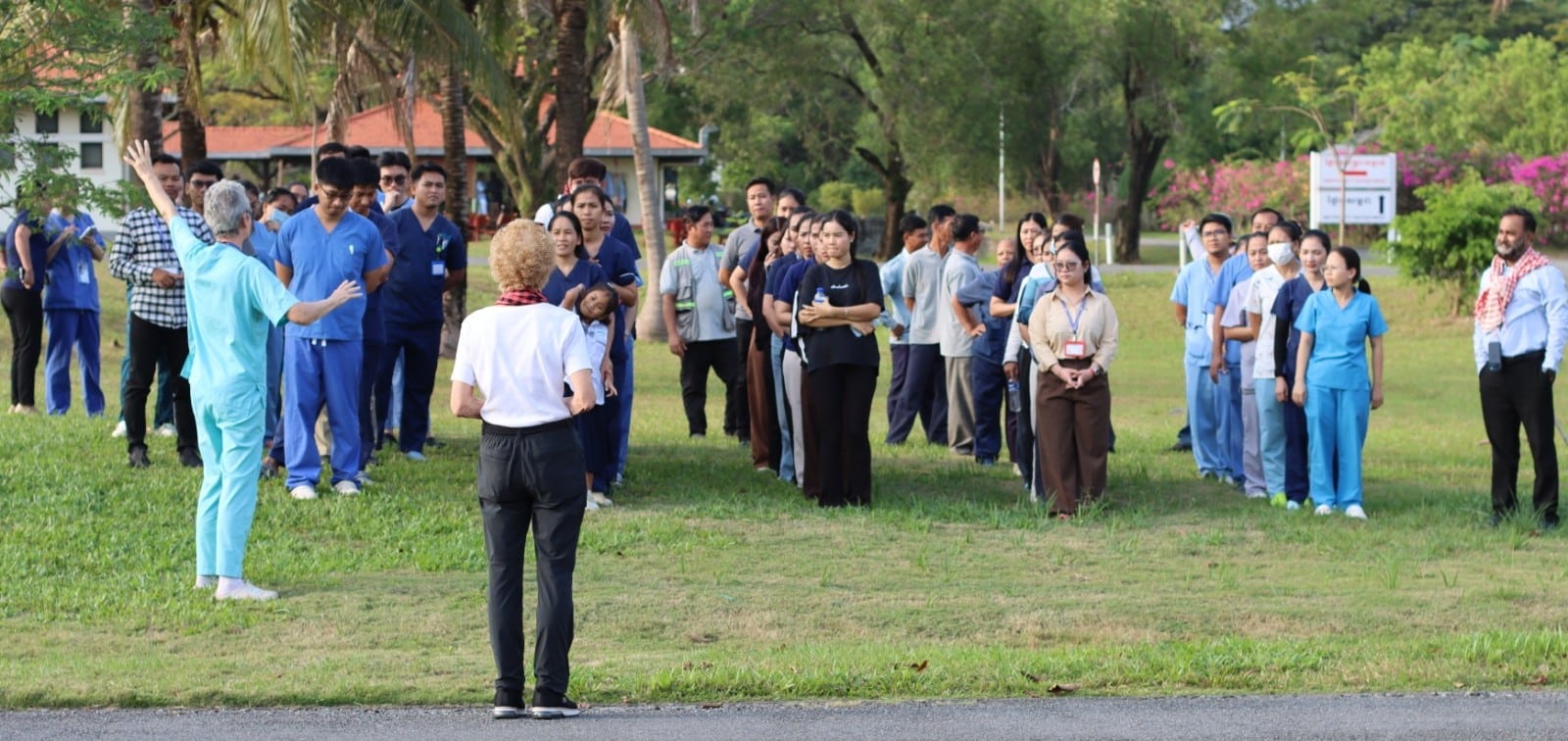
All staff, not just supervisors, played a part in these trainings. “We did a practice drill with four stations,” said Dr. Evashwick. “The maintenance staff was wheeling me in a wheelchair and one of the HVO doctors pretended to collapse on the floor. The whole staff talked – what do we do about this? It showed that everyone needs to be engaged.” The SDSU team talked with the maintenance staff afterwards and found that they were all happy to be participating. Dr. Evashwick said, “We went from, ‘this is a thing administrators need to worry about,’ all the way down to the front line. This isn’t just for accreditation – this is for everyone’s safety.”
“We got everyone thinking more,” Dr. Evashwick said. “A nurse stopped me while I was walking down the hall to tell me how valuable the training was. She said she wished we could do more and asked if we would come back.” Ms. Teinila commented, “I would go back immediately, if possible.”
There is still plenty of follow-up to be done. The team worked on Standard 10 of the Cambodia Hospital Accreditation Standards. There are 11 standards, so there is much more to do.
HVO hopes to make this project the beginning of a regular track of management training and support, similar to the focus on specific clinical areas. April Pinner, HVO’s Executive Director, said, “HVO has been exploring opportunities to expand our support for partners in health administration and management for several years, so I was thrilled that we were able to facilitate this collaboration. I was deeply impressed by what this team, together with their colleagues at SKMH, was able to accomplish in such a short time. We know that our clinical training activities are more robust and more sustainable when organizations invest in strengthening their management systems and capacities as well as clinical care. This is an exciting and logical expansion of HVO program areas.”
HVO is grateful for SKMH’s willingness to try a new type of volunteer assignment. HVO looks forward to continued partnership with SKMH as we work together to improve safety for all staff, patients, visitors, and HVO volunteers of all disciplines.