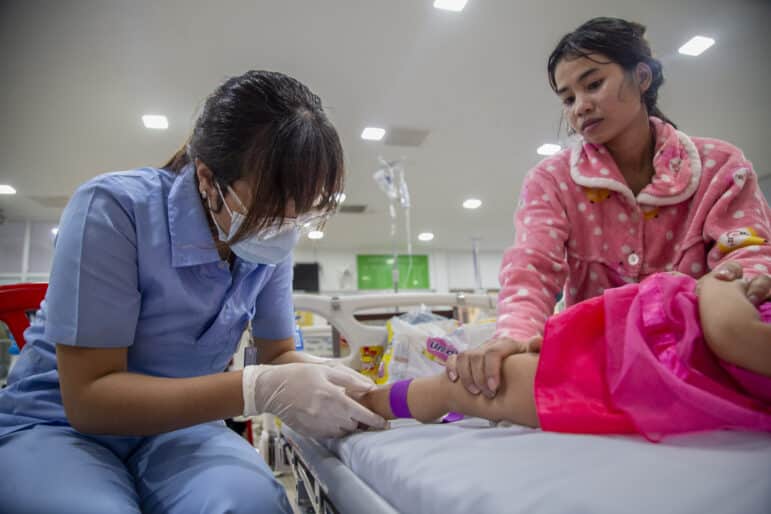
In 2008, children diagnosed with cancer in Cambodia had few options. Hospitals such as Angkor Hospital for Children (AHC) lacked the specialized training and resources needed to provide cancer treatment, and many patients were turned away. Recognizing an opportunity to change that reality, HVO volunteers partnered with AHC staff to build local expertise and strengthen pediatric oncology services. Over nearly two decades of collaboration, that investment has transformed cancer care not only at AHC but also at pediatric hospitals across the country that have looked to AHC as a model. The results have been remarkable. In 2017, the survival rate for patients at AHC with leukemia was zero percent. Today, it is 66 percent.
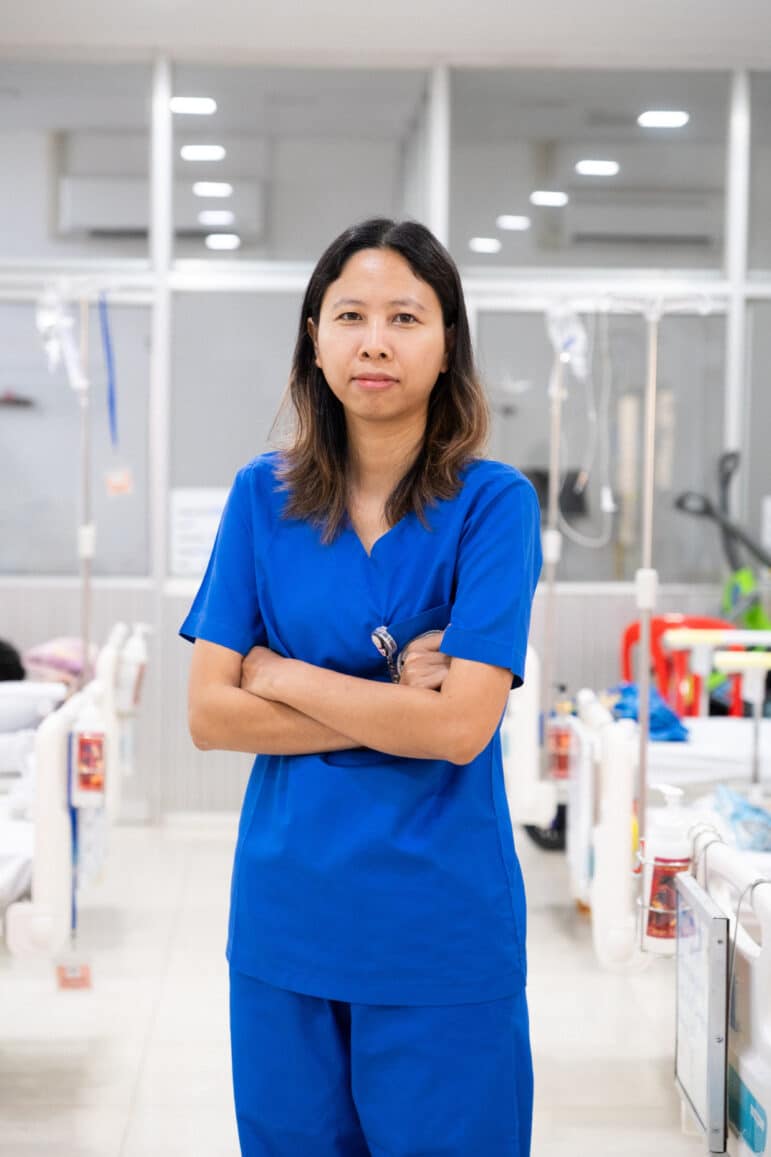
Leading the oncology team at AHC is Dr. Bun Sereyleak. When she was young, her mother was very sick. Thankfully, her mother recovered, but the experience inspired Dr. Sereyleak to study medicine to help others. “It was very challenging,” said Dr. Sereyleak. “My mom supported me every step, paying for school fees. My mother is my inspiration and my teacher.” During her four years as an oncologist at AHC, she has received training from multiple HVO volunteers, including Drs. Bruce Camitta, Ben Watkins, and Frank Keller. “We learn from each other,” said Dr. Sereyleak. “One volunteer showed me how to perform lumbar punctures, bone marrow aspirations, and biopsies, and showed me how to look through a microscope to find cancerous cells.” The mentorship has extended beyond volunteer visits to AHC. Dr. Watkins arranged for Dr. Sereyleak to spend time training at Manning Family Children’s, part of Tulane University, where he serves as a professor, giving her an opportunity to deepen her knowledge of pediatric oncology.
Because Dr. Sereyleak’s formal education was mainly as a general practitioner, she welcomes the specialized oncology training. “My first week here, a patient of mine died,” she said. “I saw many patients die my first year. I didn’t have confidence, and sometimes I felt hopeless. I asked myself, ‘How can I do better than this?’ Now, I have learned from my patients, my colleagues, and my mentors. Recently I saw a two-year-old patient with many complications. I was able to identify treatment effectively and now she is healthy and can go to school.” The training, mentorship, and educational opportunities have strengthened not only Dr. Sereyleak’s clinical expertise but also her confidence as a leader. After only a few years at AHC, she was promoted to Chief of Oncology and invited to work with the Ministry of Health to develop national cancer care protocols, helping shape the future of oncology care for patients across Cambodia. Dr. Sereyleak is happy to have a chance to share the impact of her training with others. “If I have knowledge, I shouldn’t keep it to myself,” she said. “I should share it with everyone. Not just with my staff, but with the whole country.” The effects of shared knowledge become exponential. Thanks to the efforts of Dr. Sereyleak and her HVO mentors, in a relatively short time, AHC has become a center of hope where once there was nowhere to go. “We now see that patients come from every province,” said Dr. Ben Watkins. “Now they know this is where you can be treated. The entire country is looking toward AHC.”
Dr. Frank Keller, a professor at Emory University, took his first HVO volunteer trip to AHC in 2018 and has returned three times. “It’s great work,” he said. “This has developed into a program providing care to children in Cambodia with life-threatening diseases. We are offering hope to a population who, previously, would not have survived. How can you not be involved in that?” Dr. Keller has been involved in Dr. Sereyleak’s training since she started at AHC. “She has matured into such an insightful person,” Dr. Keller said. “I’m remarkably impressed with her skills. She has an ability to see what needs to be done and then gets it done.” Dr. Watkins, who began volunteering in 2013, was similarly impressed with Dr. Sereyleak’s quick growth. “Her ability to teach has grown so much,” he said. “She is training two younger fellows, along with nurses and other physicians. She has also gained more confidence, and I can see the impact. We relied heavily on HVO to help with her training and get her to the point she is at now. You can have good intentions and work done by people in the US, but it’s never going to be sustainable without someone local, in the hospital, actually doing the work. None of this would be possible without people like Bun.”
“This” refers to the 66 percent increase in survival rate for patients with leukemia, AHC’s growing ability to treat multiple types of cancers, weekly case calls with volunteers to improve diagnoses and treatments, and the developing network of pediatric hospitals now working together to create an efficient and life-saving safety net for critically ill children. “Pretty much every child diagnosed with cancer wouldn’t have survived before,” said Dr. Keller. “We have weekly meetings to discuss patients with the team in Cambodia and there is at least one new case every week. I would say over half of those children are going to survive because of the care provided by AHC and our role as advisors. Word has gotten out about improved care, so more and more patients are coming.” Before HVO partnership, AHC did not have a dedicated pediatric oncologist. Now, there are seven trained fellows.
In addition to training physicians and nurses, the HVO volunteer team has connected AHC with laboratories in the United State to help with essential testing that isn’t available in Cambodia. Many of these tests are performed free of charge, thanks to HVO connections. “HVO has been the driver,” said Dr. Watkins. “Without HVO, none of this would have happened.”
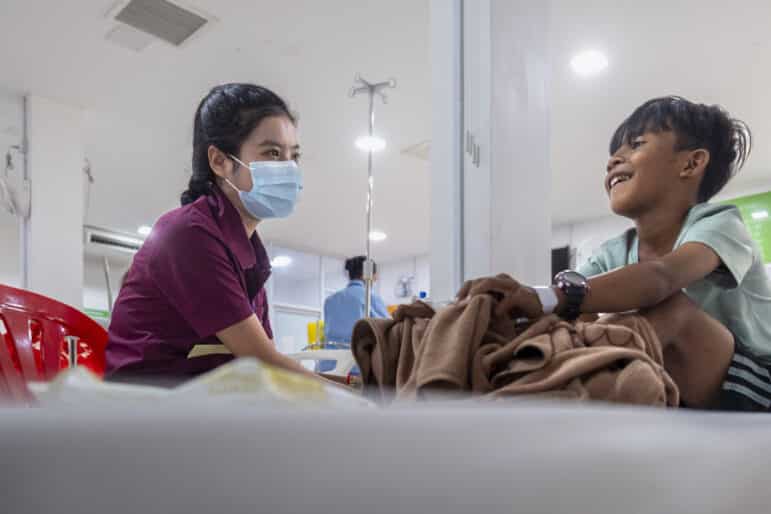
Another important connection has been among the pediatric hospitals of Cambodia. Inspired by AHC’s success, several have begun to develop oncology treatments. “They saw what we had achieved, and it spread like a fire,” said Dr. Watkins. These hospitals are now forming a plan together to create a network of pediatric cancer care where different centers have different areas of expertise. That way, each hospital can focus limited resources on one or two types of cancers. Each hospital would then know where to refer patients for the best possible care. “AHC has started to focus on leukemia and retinoblastoma. Another hospital has an interest in focusing on sarcomas and neuroblastoma,” said Dr. Keller. “This is the next step in cancer care for the children of Cambodia. In 2024 and 2025, Dr. Camitta and I traveled to different hospitals to foster this collaboration, but, ultimately, it’s going to be the people in country who will make it work. The key to improving medical care in underserved parts of the world is education. The people there must be the ones to develop the program. The most important things we can do as volunteers are providing education and mentorship. I find that a rewarding and important part of what HVO is trying to do.”
While the team has made immense progress, there is still more to do. “In a low-income country like ours, pediatric cancer survival rate is only 20%,” said Dr. Sereyleak. “In developed countries, it is more than 80%. When HVO comes to us, it has a huge impact on our staff and their education. Volunteers share how they do things. Their countries have been practicing oncology care for many years. But we have just started. Everything is new, and we do not have expertise. To improve the quality of care in Cambodia, we need your help.” The team of HVO volunteers continues hosting weekly case conference calls and managing pathology requests.
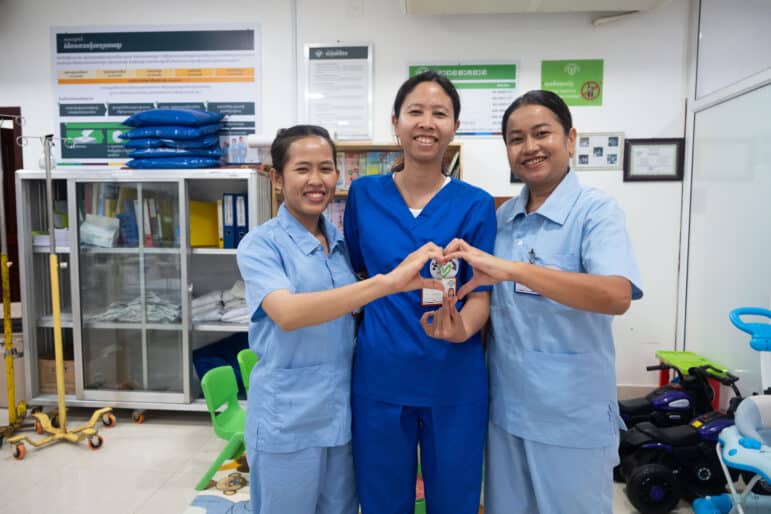
Dr. Sereyleak is grateful for the support and thrilled with the incredible progress made on treating pediatric cancers. “I would like to thank all the volunteers for sharing, for teaching me, and for guiding me to be the Chief of Oncology today,” she said. “You have been my teachers and keep coming here to help me and the children of Cambodia. I am asking HVO to send more volunteers. We need more education for our nurses, pharmacists, and lab technicians. We cannot achieve our goals alone. We need your partnership. We need your support.”
The story of pediatric oncology in Cambodia demonstrates what sustainable global health partnerships can achieve. “We are a community now,” said Dr. Watkins. “These people who wouldn’t necessarily have worked together are all working towards a common goal. Through the work of HVO, ASH, and AHC, we’ve seen this massive expansion in treating patients, but our job isn’t over. It’s going to take effort and resources from volunteers, and it’s exciting to see what the next phase is going to look like. Your involvement in this project leads directly to more children’s lives saved.”
To learn more about volunteer opportunities for oncologists and hematologists, contact Lauren Franklin or visit HVO’s hematology and oncology specialty pages.